You've Been Doing GEO Without Knowing It. Here's How to Do It on Purpose.

You did everything right.
You wrote the blog posts. You optimized your headings. You got the backlinks. You even figured out what a meta description is and why it matters, which, honestly, deserves more credit than it gets.
And then Google released AI Overviews, and suddenly half your traffic strategy is answering questions before anyone clicks your link.
Welcome to the part where the rules change again. (Yes, again. Grab a coffee.)
If you've been hearing the term "generative engine optimization"—or GEO—and quietly nodding along while having absolutely no idea what it means, this post is for you. We're starting from the beginning.
So What Is GEO, Actually?
Generative engine optimization is the practice of making your content visible, credible, and citable within AI-powered search results.
Where traditional SEO is about ranking in Google's blue links, GEO is about becoming the source that AI tools, like Google's AI Overviews, ChatGPT, and Perplexity, pull from when they generate an answer.
The distinction matters more than it sounds.
With SEO, someone searches a term, sees your link, clicks it.
With GEO, someone asks a question, gets an AI-generated summary, and your brand either appears in that summary or it doesn't. The click may never happen. The citation is the win.
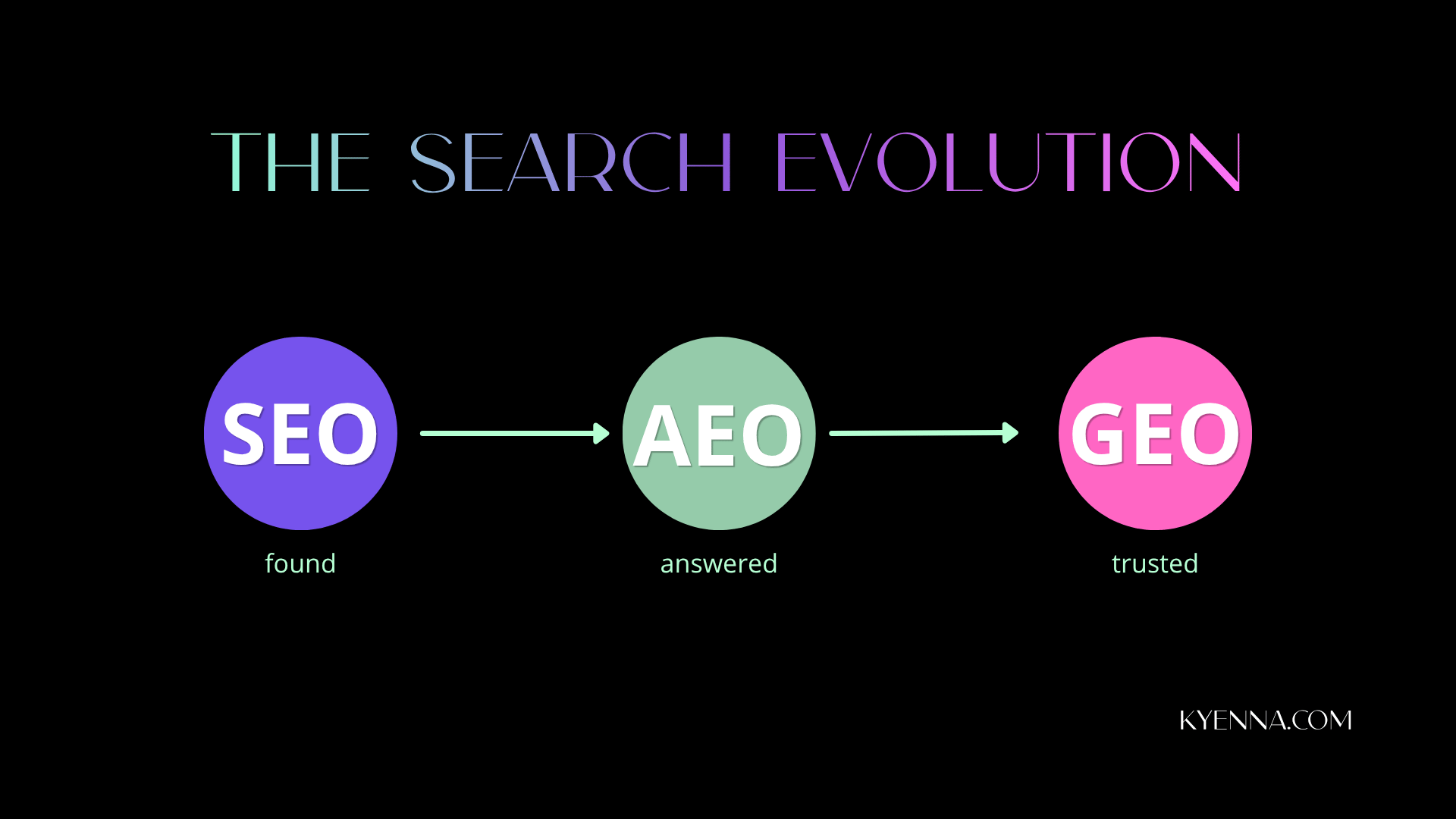
Think of GEO as the final evolution in a three-stage chain. SEO gets you found. AEO gets you answered. GEO gets you trusted. If that sounds vaguely like a Pokémon evolution arc, that's because it basically is… Each stage builds on the last, and skipping straight to the third without the foundation doesn't work.
The other thing worth saying: GEO isn't actually new. Brand authority, off-site reputation, being the name people reach for when they need an expert in your space has always been part of good marketing. What's new is that AI search made it measurable and urgent. We finally have a term for the thing that quietly separated forgettable businesses from memorable ones, and now we're being asked to do it on purpose.
Why GEO Is Getting More Attention Right Now
At Google Marketing Live 2026, Google made clear that AI-driven search isn't a feature they're testing—it's the direction everything is moving. AI Overviews are now the default experience for a growing share of searches, particularly informational ones, and Google is actively expanding how sources and inline links appear within those responses. Being cited is becoming a primary form of visibility, not a bonus.
The same shift is happening across tools like Perplexity and ChatGPT, which more people are using as first-stop research tools rather than traditional search engines.
This means AI tools are now gatekeeping information. They decide what gets surfaced, what gets cited, and what gets ignored, and they're making those decisions based on signals that don't map cleanly onto traditional SEO metrics.
There's also a newer layer worth understanding: agentic search. AI isn't just answering questions anymore—it's completing tasks on users' behalf, from research to recommendations to purchases. If your brand isn't established as a trusted source, it doesn't get selected when the AI is acting as an agent. That's a different kind of invisible than not ranking on page two.
How GEO Fits Next to SEO and AEO
Quick version, because this acronym pile deserves one paragraph and not three: SEO gets you ranked, AEO gets you cited as the answer, and GEO gets you trusted enough that AI references you even when nobody clicks through. They overlap far more than they compete. You're sequencing them, not choosing between them.
If you want the actual side-by-side — full definitions, where they diverge, and which one to do first — that's its own post: SEO vs AEO vs GEO: What Small Business Owners Need to Know. From here, we're staying on GEO.
How GEO Actually Works
There's no single GEO algorithm to reverse-engineer. What we do know is that AI systems prioritize sources that demonstrate depth, clarity, and authority—and that several specific content practices make a measurable difference.
Create content with genuine depth
Surface-level articles are easy for AI to summarize and replace. Original research, specific expertise, and analysis that goes beyond "here are five tips", that's harder to replicate and more likely to be cited.
This doesn't mean every post needs to be a white paper. It means every post should contain something worth citing: a clear definition, a useful framework, a specific answer to a real question. Think of it as writing something that a smart, very time-pressed person would actually want to reference.
Structure your content for AI readability
AI tools don't read the way humans do. They scan for structure, like clear headings, direct answers near the top of each section, content organized logically rather than written to build suspense. The dramatic reveal works great in fiction. Less so when a bot is trying to extract a definition from a wall of text.
A well-executed content audit will often surface this as a gap: good ideas buried in paragraphs that AI can't easily extract. The fix is usually less about rewriting and more about restructuring.
Build authority beyond your own website
AI search now incorporates signals from forums, communities, and third-party platforms — including a feature Google calls "Expert Advice," which surfaces perspectives from places like Reddit and other online communities. Being cited somewhere else tells AI systems that you're a recognized voice in a space, not just someone who built a website and started talking.
This is one reason why backlink strategy and off-site presence still matter, even in an AI-first search environment.
Invest in evergreen content
How-to guides, tutorials, foundational explainers—these build the kind of long-term authority that AI systems rely on. A post that stays accurate and useful for two or three years will accumulate more citation signals than five posts that go stale in six months.
Your content strategy should account for this balance: some content that rides current momentum, more content that compounds over time. The irony of the content hamster wheel is that slowing down and writing fewer, better things often performs better than publishing constantly and hoping something sticks.
Rethink how you measure success
This is the one that trips people up. If you're only tracking click-through rates, GEO performance will look like a problem when it's actually working.
The metrics that matter now:
citation frequency in AI-generated responses,
branded search growth (people searching your name specifically),
your presence in "Expert Advice" features and community integrations,
and Revenue Per Page, which measures actual content value rather than raw traffic counts.
These are all wins that don't show up in traditional reports. Track these alongside your standard SEO metrics. The picture will look different and more honest.
What GEO Means for Small Business Owners and Freelancers
Yet another acronym does not mean you need to burn your content strategy to the ground and start over.
If you're already creating well-structured, original content with a clear point of view, you're closer than you think. GEO isn't a separate strategy so much as an evolution of a good content strategy. One that accounts for how search behavior is actually changing.
The closest analogy is your email list. You don't own your Instagram followers or your Google rankings — both can disappear overnight if an algorithm changes or an account gets flagged. But your email list is yours. GEO works similarly: the brand reputation you build through consistent, citable, authoritative content becomes an asset that lives beyond any single platform or search update. It's the difference between renting visibility and actually owning some of it.
The sites that will struggle are the ones that were built on volume over substance, like generic content, thin pages, keyword stuffing dressed up in headers. AI has no reason to cite any of that, and increasingly, neither does Google.
The sites that will do fine, and the ones that will be cited, are built on genuine expertise, clear communication, and content that's actually worth referencing.
That's the same thing good content has always required. The bar just got more visible.
Where to Start With GEO
If you're new to this and feeling the urge to tear your site apart, don't. Start here instead:
Audit what you have. Before building anything new, understand what's working and what isn't. A website audit will surface the gaps faster than guessing. Look specifically at whether your content is structured for easy extraction with clear answers near the top of each section, question-based headings, and no key information buried in long paragraphs.
Check your SEO foundation.GEO doesn't work without the basics in place. Title tags, internal linking, page speed, schema markup, if those aren't sorted, start there. A solid website SEO checklist covers what to prioritize.
Understand where you fall on the AI visibility spectrum. Not all content gets ignored equally. Why your website isn't showing up in ChatGPT or Perplexity is worth reading if you've already got content published and want to know why it's not being cited.
Then build forward.New content should be written with GEO in mind from the start: depth over breadth, structure that AI can parse, and topics where you have a genuine perspective to offer.
FAQ: Generative Engine Optimization
What is generative engine optimization?
Generative engine optimization (GEO) is the practice of making content visible and citable within AI-powered search tools like Google's AI Overviews, ChatGPT, and Perplexity. Where SEO focuses on ranking in traditional search results, GEO focuses on becoming a trusted source that AI models reference when generating answers.
Can a small business actually compete on GEO?
Yes, and arguably more easily than on traditional SEO. GEO rewards genuine expertise, a clear point of view, and content that's actually worth citing — none of which require a big budget or a backlink war. A solo operator who knows their niche and writes about it clearly has a real shot at being the source AI reaches for. Thin, generic, high-volume content is what struggles, and that's usually the bigger players' problem, not yours.
Do I have to tear down my content strategy to start doing GEO?
No. If you're already publishing well-structured, original content with a clear point of view, you're most of the way there. GEO is an evolution of a good content strategy, not a replacement for one. You're adjusting for how search behaves now, not starting over.
How do I know if GEO is working?
Traditional click-through rate isn't the right metric for GEO performance. Instead, track branded search growth (how often people search your name directly), direct traffic, and whether your site is being cited as a source in AI-generated responses.
How long does GEO take to show results?
Like SEO, GEO is a long-term play. There's no shortcut to building the kind of authority and trust that AI systems recognize. Consistent, structured, original content over time is what moves the needle — not a one-time optimization sprint.
What kind of content performs best for GEO?
Content with genuine depth and a clear point of view. Original analysis, specific expertise, well-organized how-to guides, and foundational explainers tend to perform well. Thin, generic content doesn't give AI models much reason to cite it.
What is agentic search?
Agentic search refers to AI that completes tasks on a user's behalf: researching options, making recommendations, even facilitating purchases. Google highlighted this shift at Google Marketing Live 2026. For brands, it means visibility in AI is about being trusted enough that an AI acting as an agent will select you over alternatives.