SEO vs AEO vs GEO: What Small Business Owners Need to Know
Somewhere in the last few years, search optimization went from one acronym to three. SEO, you probably know. AEO started showing up in marketing content as AI search tools became mainstream. And GEO arrived more recently in blog posts and newsletters.
If you read the headline, had a reasonable amount of skepticism about whether this was a real thing or content padding, and moved on, I get it. But it's a real thing, though the definitions are still settling.
Here's what all three actually mean, where they overlap, and the priority order is for most small businesses. (Yes, there is a priority order. It's not a toss-up.)
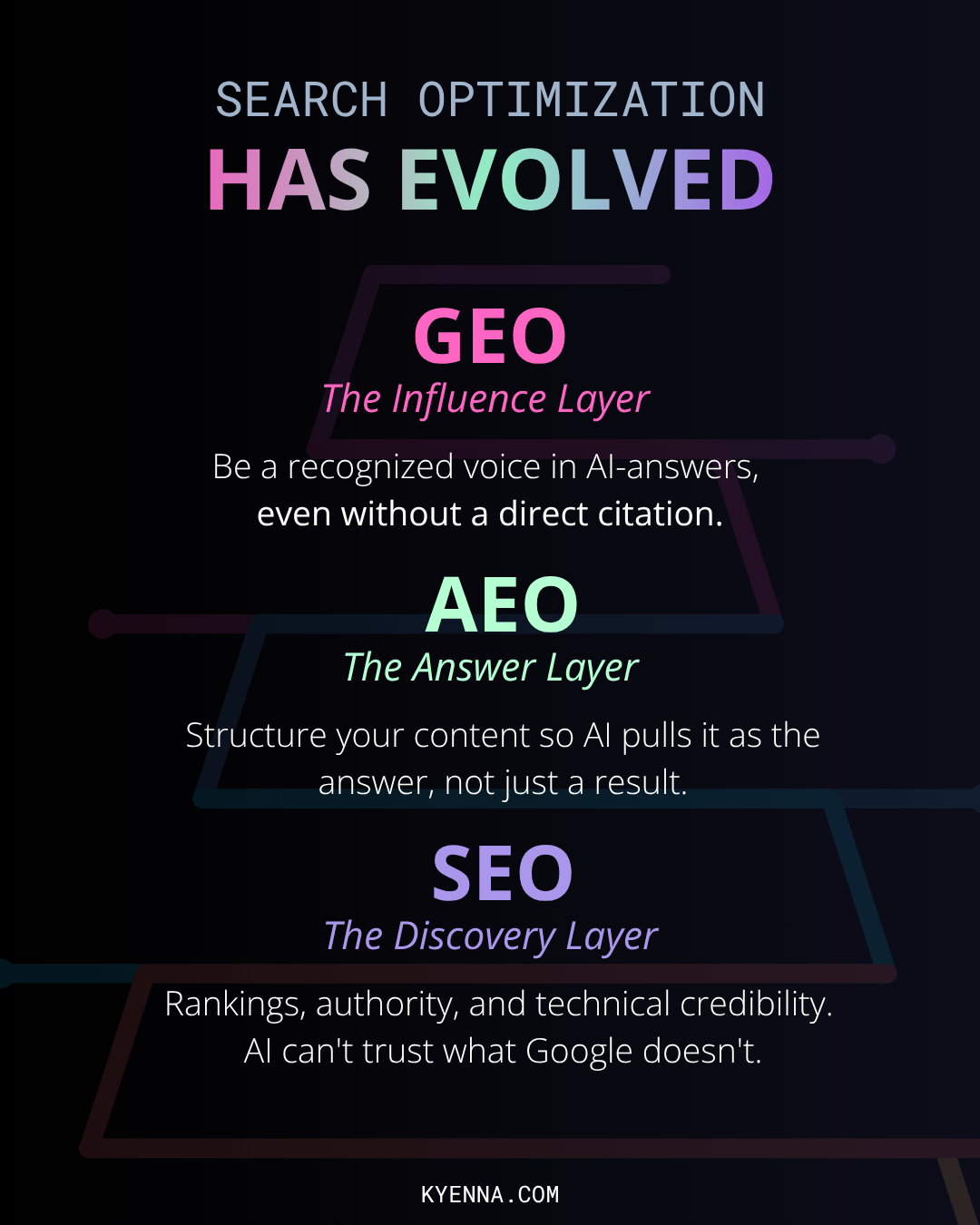
SEO: The foundation
Search engine optimization is about making your website visible in traditional search results. When someone searches Google for "content strategist for SaaS companies" or "how to write an about page," SEO determines whether your content appears and where.
The signals are well-established at this point: on-page elements like title tags, headings, and keyword placement; technical factors like site speed, mobile responsiveness, and crawlability; off-page authority like backlinks and domain trust.
None of this has changed fundamentally in years. What's changed is that it's no longer the only system doing the scoring.
SEO is the foundation that everything else builds on. If your site isn't indexed, isn't technically sound, and search engines can't find or understand your pages, AEO and GEO are irrelevant. Get the foundation right first.
AEO: The layer that gets you cited
Answer Engine Optimization is specifically about being selected as the direct answer in AI-generated responses—Google AI Overviews, Perplexity citations, Bing Copilot, ChatGPT with browsing. The distinction from SEO is not semantic. Traditional search ranks you in a list of options; AI search selects you as the answer. A site can rank on page one of Google and still not appear in a single AI Overview because the criteria are different.
AI tools prioritize content that can be extracted and presented without interpretation. That means direct answer blocks near the top of relevant sections, FAQ sections marked up with FAQPage schema, question-formatted headings, and enough topical depth to signal genuine expertise rather than surface coverage.
AEO is the layer most small business sites are currently missing. They've been optimizing for traditional search for years and never added the structural elements that AI tools look for. The gap is addressable, and most of it is writing decisions rather than technical work.
GEO: The newest piece
Generative Engine Optimization is the most recent addition to the acronym pile, and the definitions are still being worked out. The distinction from AEO is subtle but genuine.
AEO is about being cited—appearing as a linked source in a Perplexity response or AI Overview.
GEO is broader: it's about being a recognized voice in AI-generated content about your industry or category, even in responses that don't specifically cite a source.
The practical difference:
AEO asks, "Does AI cite my website when someone searches for my service?"
GEO asks, "When AI generates general content about my field, does my perspective get incorporated?"
For most small businesses, GEO is a longer-term build. It develops as a consequence of doing SEO and AEO consistently and well over time, not as a separate set of tactics.
Ask ChatGPT about your industry today, and your name almost certainly won't come up. That's normal. Some of that will change as you build topical authority (just probably not by next quarter).
Where they overlap (which is most of it)
Good content strategy covers the majority of all three simultaneously, which is the most convenient thing about this entire situation.
Clear, well-structured, genuinely useful content benefits SEO, AEO, and GEO. Schema markup helps AI citation and indirectly improves how search engines parse your pages. Topical depth and authority signal expertise across all three systems. E-E-A-T—Experience, Expertise, Authoritativeness, Trustworthiness—is essentially the criteria all three use to assess credibility, just expressed differently in each context.
The differences are in specific implementation. FAQs are an AEO-specific move. Backlink building is primarily an SEO lever. GEO develops through consistent publishing over time. But the underlying work—producing good, well-structured content about topics you actually know—serves all three. You're mostly sequencing the implementation, not choosing between competing strategies.
What to prioritize and in what order
Start with SEO fundamentals.
Title tags, meta descriptions, heading structure, site speed, mobile responsiveness, SSL, basic indexing.
These are the baseline, and the baseline is where a surprising number of small business sites are still incomplete. Without it, everything else is building on an unstable foundation.
Add AEO elements to your most important pages.
FAQ sections schema, question-formatted headings, direct answer blocks at the top of major sections.
If you have a services page, a homepage, and a few blog posts, add FAQ sections to all. One focused afternoon.
Let GEO develop as a byproduct.
Publish consistently, build topical depth, structure your site so AI tools can read and trust it.
GEO isn't a separate set of tactics for most businesses (thank goodness). It's what happens when you do the other two well and keep doing them.
How to check where you stand right now
For SEO: Google Search Console is your first stop. It shows what's indexed, what's ranking, and what's getting impressions. If you haven't set it up, that is the actual first move, before anything else on this list.
For AEO: Search your primary service category in an incognito window and look for an AI Overview. If one appears, check whether you're in it. Run your main service questions through Perplexity and see whether you're cited as a source.
For GEO: Ask ChatGPT or Gemini an open-ended question about your industry and see whether your name or perspective comes up. It almost certainly won't at first. That's normal, and it's a long-term build… the kind where you plant seeds in 2026 and someone mentions your name in an AI response in 2028, and you'll have completely forgotten you were doing this.
The one thing that moves all three
If there's a single investment that improves SEO, AEO, and GEO simultaneously, it's building a cluster of well-structured content around the topics you want to own. Try for three to five interconnected pieces on the same subject, each adding a different angle, all linking to each other. A single page tells a search engine you mentioned a topic, while a cluster tells it you understand the topic.
All three acronyms are ultimately asking the same question: Is this site a credible, trustworthy source for this subject? The mechanics look different, but the answer you're trying to build is the same.
Not sure where your site stands on the basics? The free 10-Point Website Quick-Check covers SEO and AEO in five minutes. kyenna.com/free-website-audit
Frequently asked questions
What is GEO in marketing?
GEO stands for Generative Engine Optimization. It's the practice of building enough topical authority and content credibility that AI tools incorporate your perspective when generating responses about your industry (not just when someone searches for you specifically). The distinction from AEO is that GEO isn't only about being cited. It's about being part of how AI represents your field, which is a longer and less predictable build than optimizing for direct citations.
Is GEO the same as AEO?
Close but not identical. AEO focuses specifically on appearing as a cited source in AI-generated search responses. GEO is broader and is about being recognized as an authoritative voice that AI incorporates when generating content about your topic area, cited or not. In practice, the strategies overlap significantly.
What does AEO stand for?
Answer Engine Optimization. It refers to structuring your content so that AI-powered search tools — Google AI Overviews, Perplexity, ChatGPT with browsing — select it as the direct answer to a query. The name reflects the shift from search engines that rank pages to answer engines that synthesize responses. If you've noticed AI tools pulling a specific paragraph or FAQ answer from a page, that's AEO working.
Do I need to choose between SEO and optimizing for AI tools?
No. The most effective approach does both simultaneously because the foundation—high-quality, well-structured content—serves all three. The difference is in specific implementation, not in strategy.
How quickly does each one show results?
SEO compounds over months. AEO can show results faster for specific question-based queries once your content is indexed and structured correctly. GEO is a longer-term build measured in years, not weeks. So, plan accordingly.
I'm a small business with limited time. Which one first?
SEO fundamentals. Then AEO elements on your three most important pages. GEO develops as a byproduct of doing both consistently. Definitely don't try to do all three at once from a standing start.