Why Your Website Isn't Showing Up in ChatGPT or Perplexity
You Googled yourself. Your website showed up, or it didn't, and either way, you have a general sense of where you stand in traditional search. Then someone mentioned they asked ChatGPT for recommendations in your category and got back a list of five businesses. You weren’t there. You read the list twice because you assumed you might have missed your name the first time.
You didn’t.
This is the gap between SEO and AEO, and it's wider than most people expect, partly because "there are now two entirely different systems for search visibility" is not the kind of thing that comes up unless you go looking for it.
What are AI search tools actually doing?
Google AI Overviews, ChatGPT with browsing, Perplexity, and Copilot are not ranking websites the way traditional search does. They're retrieving content, extracting answers, and presenting those answers directly, often without the user ever clicking through to a source. Which is excellent for the user and quietly alarming for every website owner who assumed "being on the internet" and "being findable" were basically the same thing.
They're not picking the most optimized page. They're not even picking the most authoritative one. They're picking the one that's easiest to extract a clean, complete, direct answer from, meaning one that doesn't require any interpretation. "I can find this information on your site… eventually" and "I can lift a usable answer from your site right now" are very different things to an AI tool that has approximately a zillion other options.
If your website was built for traditional search, or just built to look good and communicate your services, AI isn't ignoring you because you've done something wrong. You're structured for a different job than the one it's trying to do.
Why ranking on Google doesn't automatically translate to AEO
Traditional SEO rewards comprehensive content, backlinks, and relevance.
AEO rewards structured content that can be parsed and presented as a direct answer without interpretation.
That's a meaningful difference. A 2,000-word blog post that thoroughly covers a topic might rank on page one of Google and still get zero citations in Perplexity, because the actual answers are buried inside paragraphs rather than set up in clearly labeled, extractable blocks. The AI scanned it, found nothing it could lift cleanly, and moved on to the next result, which happened to have an FAQ section.
The good news is that this is almost always a structural problem, not a quality problem. The content is fine. It just isn't formatted in a way that AI tools know how to work with.
Why isn’t your site appearing in AI tools?
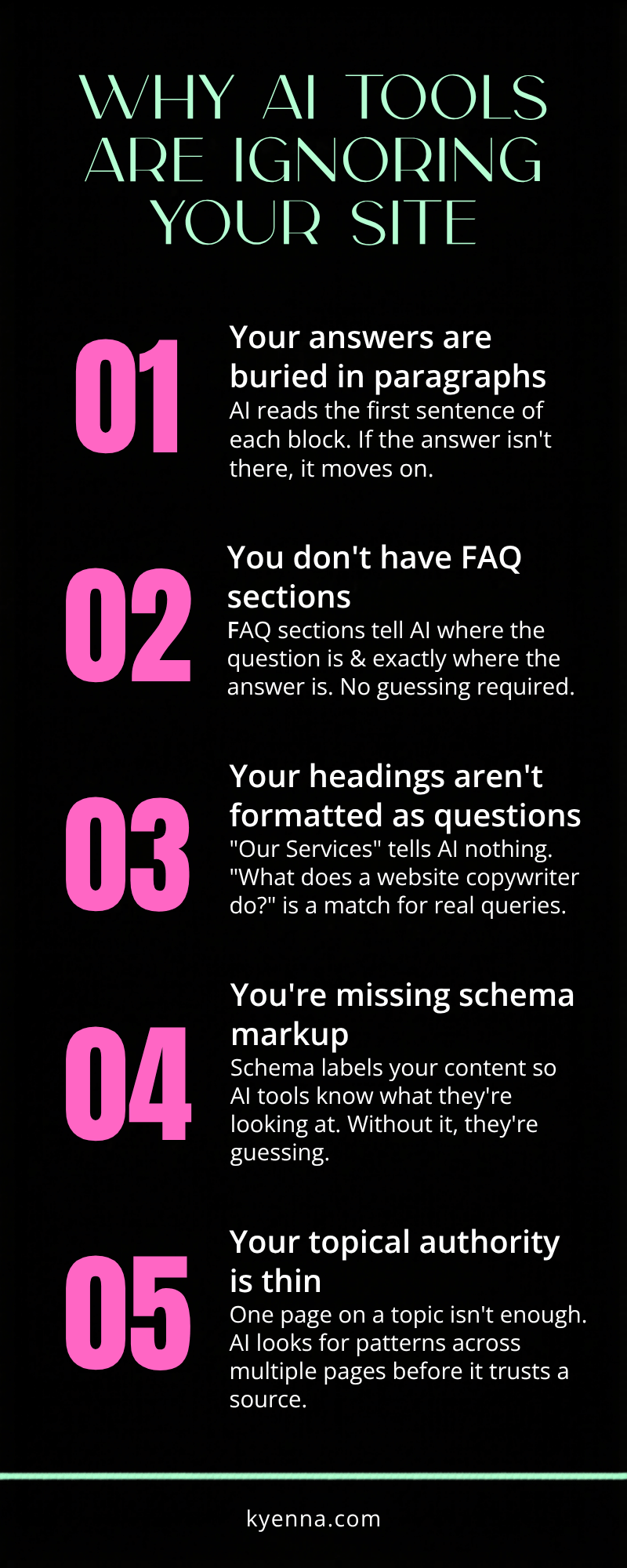
Your content buries the answers.
Most website copy is written with context first and the answer somewhere in the middle, because that's how persuasive writing tends to work for humans who are reading. AI tools are not reading your setup. They're looking for direct answers near the top of each section, and if the answer is in the middle of a paragraph after three sentences of lead-in, it gets skipped. Every single time, for every single query.
You don't have FAQ sections.
An FAQ section is one of the highest-leverage AEO moves available right now for most small business sites. Not because it's technically difficult. Because "add an FAQ section" sounds like a minor task rather than a visibility strategy, which means it keeps losing to things that feel more impressive to prioritize.
FAQ sections do one thing extremely well: they tell AI tools exactly where the question is and exactly where the answer is, with no guessing required.
Your headings aren't formatted as questions.
"Our Services" and "Why Choose Us" are navigational headings. They tell AI tools almost nothing about what's actually being answered on the page. "What does a website copywriter actually do?" and "How long does a website project take?" match the format of real queries, which means AI tools recognize them as answer candidates and look in those sections for content to cite.
You're missing schema markup.
Schema is code that describes your content to search engines and AI tools in explicit terms: this is a FAQ section, these are the questions, these are the answers. FAQPage schema, HowTo schema, and Article schema are the most relevant for most small business sites.
On Squarespace, adding schema is a copy-paste operation in Settings > Advanced > Code Injection. Free schema generators build the code from your questions and answers. It takes about twenty minutes, including the time to read the instructions twice because the first read didn't fully land.
Your topical authority is thin.
One well-written page about a topic is a start. A cluster of three to five interconnected pages on the same subject, each linking to the others, each adding a different angle, builds the pattern that tells AI tools this site consistently and accurately covers this subject.
AI doesn’t assess pages in isolation. They assess whether a site actually knows what it's talking about, and "I wrote one post about this in 2023" is not a compelling case.
How to check whether you're appearing in AI searches
Search your target questions in an incognito window and look for an AI Overview. Run your primary service category and location through Perplexity and see whether you're cited. Ask ChatGPT with browsing enabled directly about the service you offer in your area.
If you've been publishing structured content for a few months and still aren't appearing, the answer is almost always the same: missing schema, no FAQ sections, or content that gives answers in meandering paragraphs instead of extractable blocks. It's rarely a mystery once you know what you're looking for.
Where do you start?
Pick your three most important pages—homepage, primary service page, and your most-visited blog post—and add five to eight FAQ questions and answers to each. Write the answers the way you'd answer a real person who just asked: complete, direct, no preamble. Then add FAQPage schema to those same pages.
After that, go through your H2s and H3s on those pages and reformat any that aren't question-formatted where it makes sense. "What's included in my copywriting package?" is more useful to an AI tool than "Package Details." The rewrite (should) take less than three minutes per heading.
None of this requires a developer. It's writing work, mostly, and you can do the majority of it this week.
If you want to know where your site stands before you start, the free 10-Point Website Quick-Check covers both SEO and AEO in yes/no format. It should only take five minutes (and if it doesn’t… that just shows how needed it was). kyenna.com/free-website-audit
Frequently asked questions
Does my site need to rank on Google to be cited by AI tools?
Not necessarily, but it helps. AI tools prioritize content that's crawlable, indexed, and clearly structured. A site with no SEO foundation is harder for AI to find in the first place. But a site with solid SEO that hasn't added AEO-specific structure gets skipped regularly. Both matter.
How long does it take for AI tools to start citing my site?
It varies, but structured content—particularly FAQ sections with schema—can surface in AI Overviews surprisingly quickly after indexing, sometimes within days of a page being crawled. Unlike traditional SEO, which compounds over months, AEO can show results faster for specific question-based queries if your content is structured correctly. Emphasis on "if."
Can I do AEO on my own, or do I need a developer?
The content elements are writing decisions, not technical ones. Adding FAQ sections, reformatting headings, and writing direct answer blocks require no developer access at all. Schema markup is the closest thing to technical work involved, and on most website platforms, it's a copy-paste operation. If you can update your website's text, you can add FAQPage schema.
My site is on Squarespace or Showit. Does that affect AEO?
The platform matters less than the content. All major website builders support schema markup via code injection or settings. The structural and writing changes are the same regardless of where your site lives.