AEO vs SEO: What's the Difference and Why It Matters in 2026
The short version: SEO optimizes your content to rank in search results. AEO optimizes your content to be selected as the direct answer—in AI Overviews, voice search, Perplexity citations, and featured snippets. SEO gets you on the list. AEO gets you chosen from it. In 2026, you need both.
SEO gets you ranked. AEO gets you answered. And no, that's not just a cute way of saying the same thing twice. In 2026, the gap between those two outcomes is wide enough that ignoring it is actively costing you ground. Let's get into it.
What SEO Is Actually Doing
Search engine optimization is about visibility in traditional search results. Type something into Google, and SEO determines whether your page shows up and where. The signals that move the needle are familiar at this point: on-page elements like title tags, headings, and keyword usage; technical health like page speed and crawlability; authority signals like backlinks and domain trust.
The goal has always been simple. Get your page into the ranked list for a given query. Higher position, more clicks. It's a model that's worked well for about 25 years, and it still works. It's just no longer the whole picture.
What AEO Is Actually Doing
Answer Engine Optimization is about being selected as the answer, not just one of the options. When someone asks a question, and Google surfaces an AI Overview before any ranked results, that content came from somewhere. When Perplexity compiles a response and cites three websites, those sites didn't necessarily rank #1/ They were just structured in a way the AI could easily parse, extract, and present. When someone asks ChatGPT something, and it references a specific article, same story.
The platforms doing this are multiplying: Google AI Overviews, ChatGPT's browsing mode, Perplexity, Copilot. The pattern is consistent across all of them/ They retrieve information from the web and present it directly, often without the user ever clicking through to a source.
SEO is about ranking. AEO is about being cited. The distinction sounds subtle. The practical gap is not.
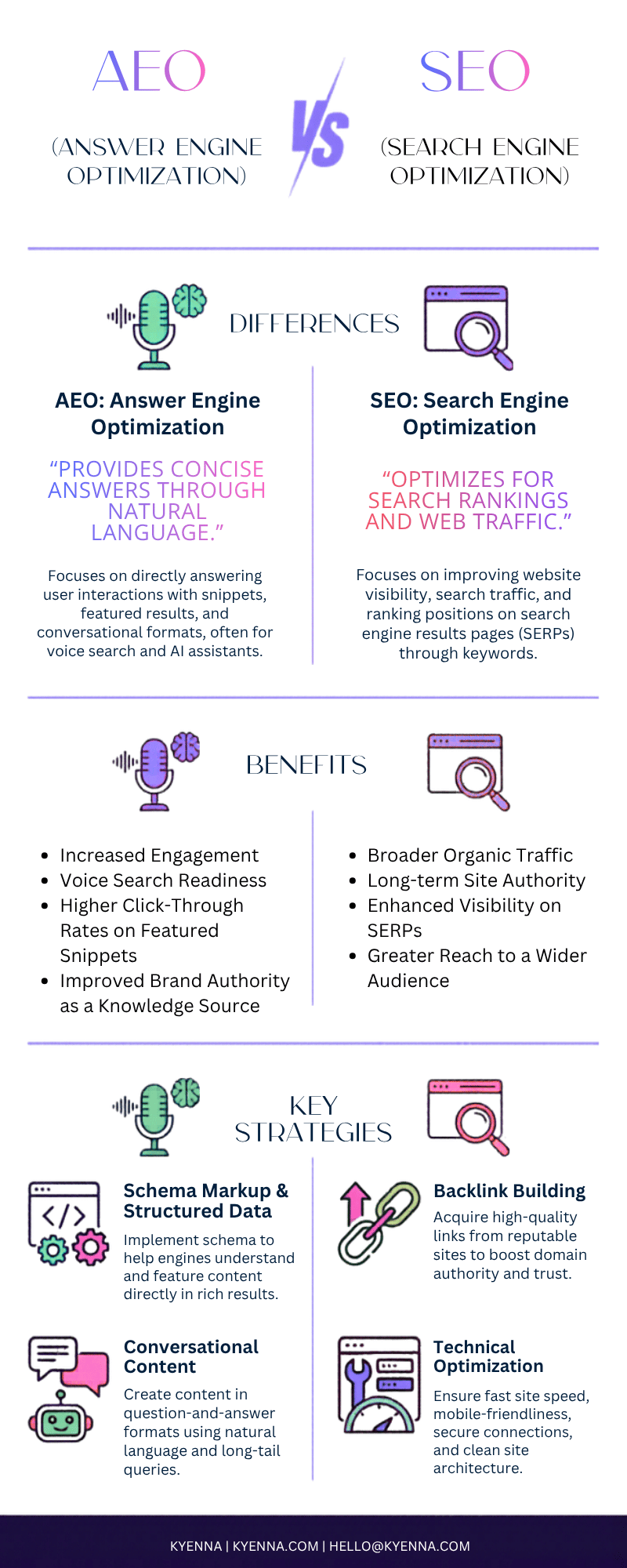
AEO vs SEO: Where They Actually Diverge
Here's the breakdown in plain terms:
Goal: SEO = appear in ranked results. AEO = be selected as the direct answer.
Content format: SEO rewards comprehensive, keyword-optimised content. AEO rewards structured content with clear, concise answer blocks—the kind AI can extract cleanly without having to interpret anything.
Technical signals: SEO cares about page speed, backlinks, and domain authority. AEO cares about schema markup (HowTo, Article), Q&A formatting, and topical depth.
Measurement: SEO is tracked through rankings, clicks, and impressions in Google Search Console. AEO is tracked through AI Overview appearances, People Also Ask inclusions, and citations in AI tools.
Timeline: SEO compounds over months. AEO can surface faster for specific question-based queries — sometimes within days of a page being indexed, if the content is structured well.
Do You Have to Choose?
No, and you really shouldn't try to. The strategies overlap significantly—both reward clear, authoritative content; both benefit from solid topic coverage; both care about E-E-A-T (Experience, Expertise, Authoritativeness, Trustworthiness). The difference is in the execution details, not the underlying principles.
The practical problem most sites face is that they've been optimising for SEO for years and haven't added any AEO-specific elements. No HowTo markup. No structured answer blocks. No headings formatted as questions. That's a fixable gap, and it's easier to close than most people expect (particularly because a lot of it comes down to how you write, not what you deploy).
What Does AEO Require?
The mechanics aren't complicated. They're just different from what most content teams are used to, which is probably why so many checklists still don't mention them.
Direct answer blocks
Near the top of any section answering a specific question, write a 40–60 word summary that directly answers it. Complete, self-contained, no preamble. AI engines are looking for content they can extract and present without doing any interpretive work. So if your answer is buried three paragraphs down after a lot of context-setting, it's getting skipped.
Q&A-formatted headings
Structure your H2s and H3s as questions where it makes sense. "What is AEO?" "How does schema markup work?" "What should a website SEO checklist include?" These match the actual queries people run and signal to AI engines that your content is organized around questions and answers—which is exactly the format they're scanning for.
FAQ sections
A structured FAQ block at the end of any informational page is one of the most reliable AEO tactics available. It explicitly tells Google: here are the questions this page answers, here are the answers.
HowTo schema
For process-based content—checklists, step-by-step guides, audit frameworks—HowTo schema tells AI engines that your content describes a defined procedure with discrete steps. It's one of the formats AI Overviews reach for most often when surfacing process-based answers.
Topical depth
One well-optimised post is good. A cluster of well-organised, interlinked posts on the same topic is considerably better. AI engines don't evaluate pages in isolation; they assess whether a site demonstrates genuine expertise in a subject. Even three to five interconnected pieces start building that signal.
None of this requires a developer. The content elements are writing decisions. On Squarespace, schema markup goes in Settings > Advanced > Code Injection. It’s a copy-paste operation that takes about ten minutes.
How to Know If Your Site Is Doing Either One Well
For SEO: Google Search Console is your primary source of truth. Check impressions and clicks by query, average position, and which pages are gaining or losing ground. If you haven't set it up yet, that's your first move — everything else is guesswork without it.
For AEO: Search your target questions manually in an incognito window and see whether you appear in AI Overviews or People Also Ask. Run your brand name and key topics through Perplexity and ChatGPT. If you're not appearing after a few months of publishing structured content, the answer is almost always the same: missing schema, missing FAQ sections, or content that buries the answer instead of leading with it.
Not sure where your site stands right now? The free 10-Point Website Quick-Check covers both SEO and AEO basics in yes/no format. It takes about five minutes. Download it here: kyenna.com/free-website-audit
Frequently Asked Questions
-
AEO stands for Answer Engine Optimization — the practice of structuring your website content so AI-powered platforms like Google AI Overviews, ChatGPT, and Perplexity select it as a direct answer to a user's question.
-
No. They work together. SEO helps your content rank in traditional search results; AEO helps it get selected as a direct answer by AI engines. In 2026, effective content strategy needs both — dropping one to focus on the other is how you end up invisible in half the places people are actually searching.
-
Clear, concise answer blocks near the top of your content, Q&A-formatted headings, FAQ schema markup, and structured data like HowTo schema. AI engines favour content that is easy to parse and directly answers a specific question — the less interpretive work required, the better your odds.
-
Not for most of it. Writing clear, structured content covers roughly 80% of AEO. The remaining 20% — schema markup — is a copy-paste of a JSON-LD code block into your site. On Squarespace, that goes in Settings > Advanced > Code Injection.
-
Faster than traditional SEO in some cases. AI Overviews can surface new content within days of indexation if it directly answers a specific query and is well-structured. People Also Ask placements can appear within two to four weeks for lower-competition questions. The caveat: "well-structured" is doing a lot of heavy lifting in that sentence.