The Small Business Owner's Guide to Showing Up in AI Search
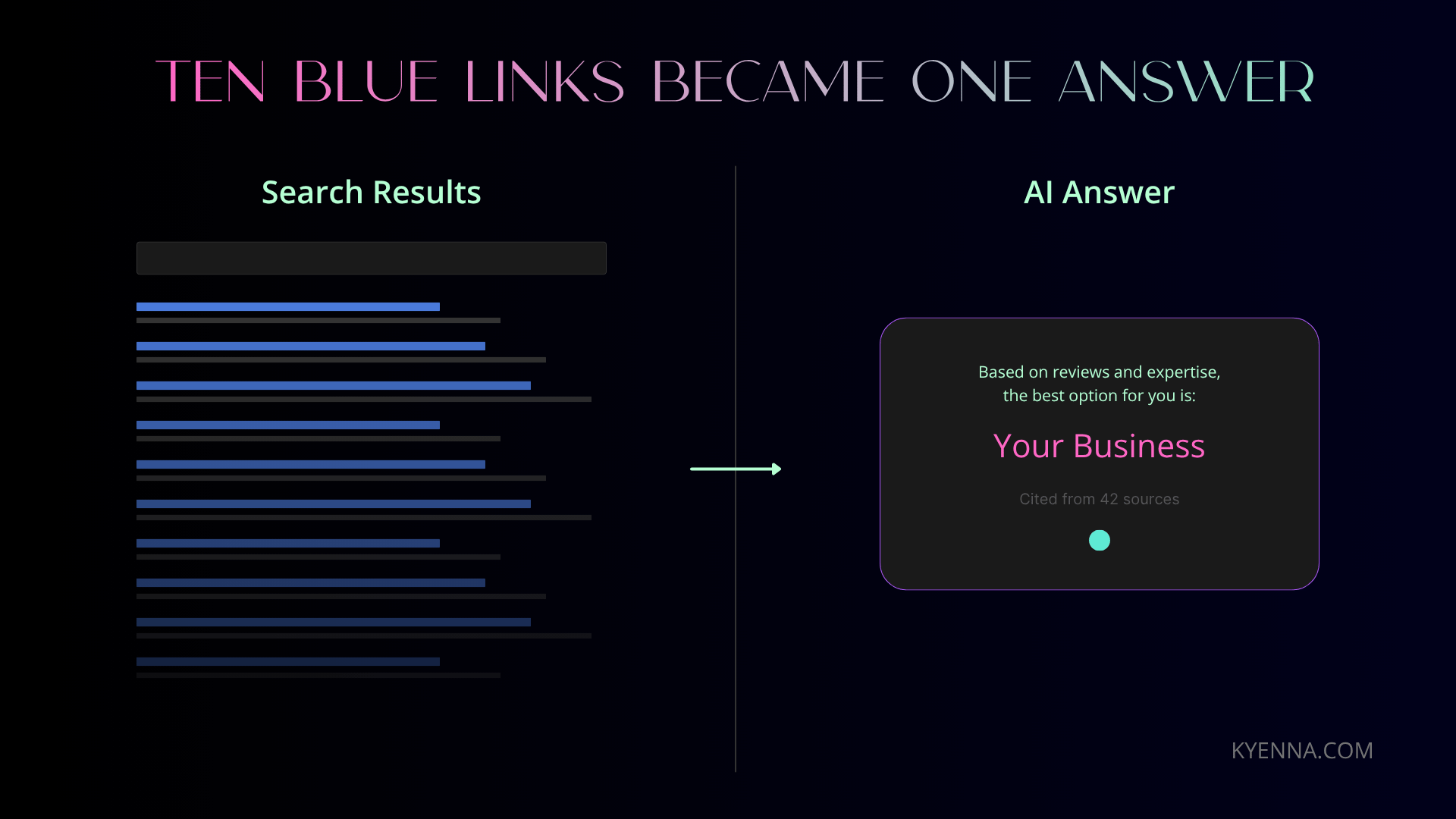
How to show up when your customers ask AI instead of Google
At some point in the last year, your customers stopped Googling and started asking.
Not asking you… Asking ChatGPT. Asking Perplexity. Asking whatever AI assistant lives on their phone. And those tools are pulling answers from somewhere, recommending businesses and services and resources, and sending people accordingly.
The businesses showing up in those answers didn’t get lucky. They built something, mostly without realizing that’s what they were doing.
I’ve spent an embarrassing amount of time reading about this so you don’t have to. What follows is what matters right now: what AI engines look for, what you can do about it, and why starting now puts you ahead of most of your competitors. You’re welcome.
Is AI search really the new Google?
Pretty much, yes. At least for a growing slice of how people find information.
When someone types a question into ChatGPT or Perplexity, they’re not getting a list of links. They’re getting a synthesized answer drawn from sources the AI considers credible, relevant, and clear. Those sources get cited. Those businesses get recommended. That traffic goes somewhere.
If your site is the one not getting pulled into those answers, here’s why that happens — and if the whole acronym situation is new to you, you’ve probably been doing GEO without realizing it.
You know you’ve made it when Claude is citing you. That’s basically the new blue checkmark.
The difference between AI search and traditional search matters because the tactics shift slightly. Traditional SEO is about ranking. AI search, what’s called AEO or answer engine optimization, is about being the answer. They overlap more than they diverge, but the emphasis is different. If you want the full breakdown without the spiral, this post covers SEO vs AEO vs GEO in plain English.
What does my website copy have to do with AI search?
More than most people expect.
AI engines read your website the same way a smart, impatient person does. Vague promises and generic positioning get skimmed and forgotten. Clear, specific language (who you help, what you do, what problem you solve) gets remembered and cited.
The difference is easier to see than to describe. Take a homepage headline like “Empowering businesses to reach their full potential.” Every AI engine on the internet will scroll right past that. Compare it to “I write website copy and content strategy for B2B companies that need to show up in search and stay there.” One tells the AI exactly who you are and what you do. The other tells it nothing.
In practical terms, that means:
Your homepage headline should answer “what do you do and for whom” in one sentence. Not a tagline. A statement.
Your About page should include specifics: experience, industries, the kinds of problems you actually solve. AI engines are drawn to specificity the same way readers are.
Your service pages should use the language your clients use when they’re searching, not the internal language you use to describe your own work.
If your website copy is still doing the bare minimum, start by figuring out why it isn’t showing up before anything else.
What kind of content do AI engines actually pull from?
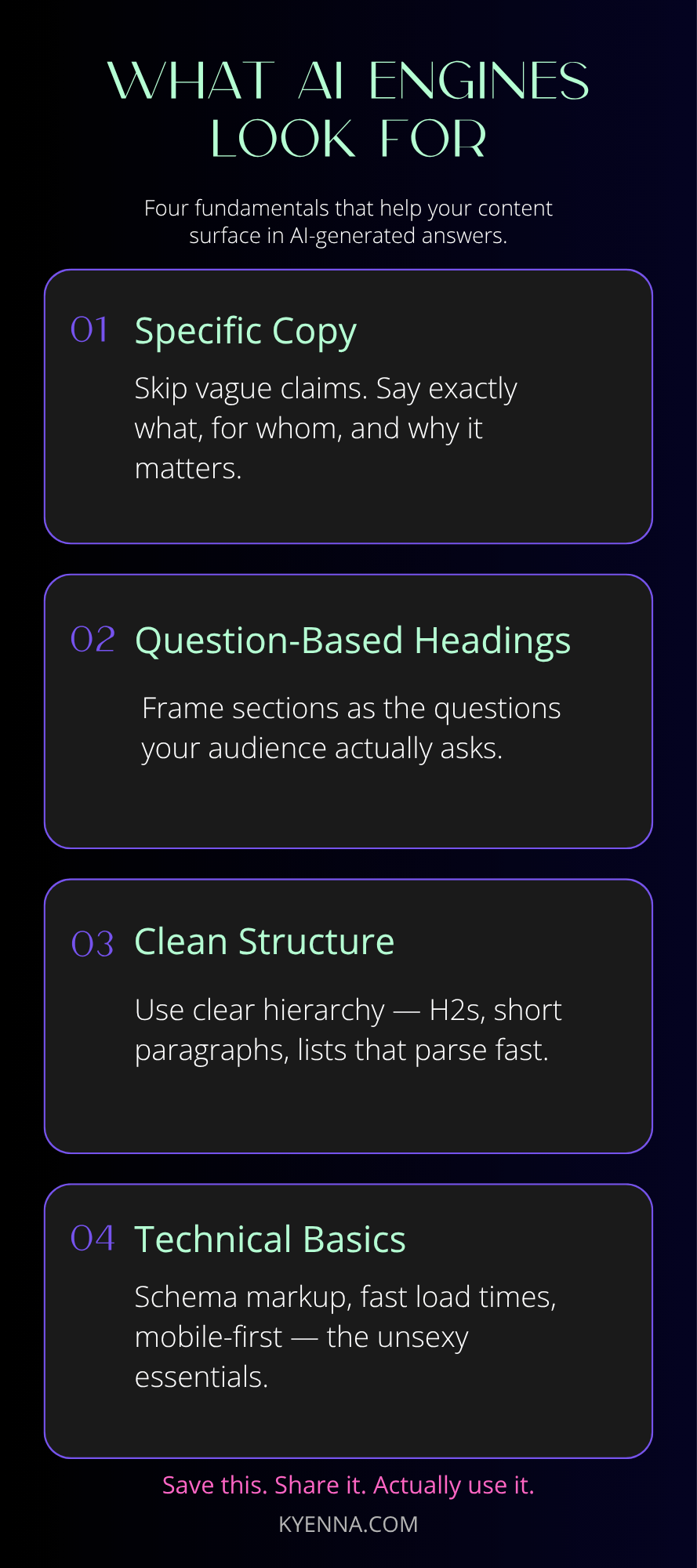
Content that directly answers a question and makes that answer easy to find.
“Our approach to client success” is not an answer to anything. “How do I know if my marketing is working” is a question someone actually types. AI engines are looking for content built around the latter, and they reward posts structured around real questions with clear, direct responses underneath them.
The heading you’re reading right now is a good example of what this looks like in practice. A question as a heading, an answer in the opening sentence. That structure is exactly what AI engines scan for when they’re deciding what to cite.
A few things that make your content more citable:
Use real questions as H2 subheadings, the way your audience would actually ask, not the polished marketing version.
Answer the question in the first sentence or two under each heading. Don’t make the reader hunt for it.
Include an FAQ section at the bottom of every post. They consistently get pulled into AI answers because they’re already formatted as questions with direct responses.
Publish at least one post per month targeting a specific “how do I” or “what is” question in your niche.
The goal is to become the clearest answer to a question your ideal client is already asking somewhere. Do it consistently, and AI engines start treating you as a reliable source, and that compounds.
How should I structure my content so AI can read it?
Structure is where a lot of otherwise good content quietly fails. Nobody sets out to write a wall of text — it just happens one unbroken paragraph at a time.
AI engines and people both need a clear hierarchy to follow. That means:
H1, H2, H3 headings that follow a logical order and tell a complete story on their own.
Short paragraphs. Three to four sentences is the ceiling.
Bullet points for lists, not run-on sentences held together with commas and good intentions.
An opening that orients the reader fast, not a “in this post we’ll explore” windup.
A close that lands the main point without introducing new ideas.
A useful test: if someone skimmed your post in ninety seconds and only read the headings and the first sentence of each section, would they understand the main point? If yes, you’ve structured it well. If they’d be lost, that’s your answer.
This applies to every page on your site, not just blog posts. Your service pages, your About page, your homepage, all of it should follow the same logic. Clear hierarchy, direct language, no buried leads.
Do the technical basics actually matter?
Yes, and they’re less intimidating than they sound.
A few things worth checking:
Page speed. Slow sites get deprioritized. Google PageSpeed Insights is free and will tell you specifically what to fix, so you don’t have to guess.
Mobile formatting. A lot of your readers are on their phones. If your site looks broken or cramped on mobile, that’s a problem before it’s an AI problem.
Schema markup. This is code that helps search engines and AI tools understand what your content is, whether it’s an article, a FAQ, or a local business listing. On Squarespace or WordPress, some of it is handled through built-in tools or plugins. My website audit walkthrough has the specifics.
Internal links. Every post should connect to two or three other relevant posts on your site. This builds a content web that both search engines and AI engines can navigate, and it keeps readers around longer than they’d otherwise stay.
None of this requires a developer. Most of it takes an afternoon, once, and then occasional maintenance.
How do I build credibility outside my own website?
AI engines don’t just read your site. They read everything, and they notice who’s talking about you, linking to you, and mentioning you elsewhere.
This is where most small businesses stall, because it sounds like the hardest part. It’s more manageable than it feels.
What actually builds external credibility:
Relevant backlinks. When another site in your niche links to your content, it signals you’re worth referencing. Guest posts, collaborations, being quoted as a source — one link from a site your audience actually reads beats twenty from places they’ve never heard of.
Unlinked mentions. AI engines pick up your business name even without a hyperlink. Industry roundups, being quoted in articles, and community conversations all build the broader picture of who you are online.
Consistent business information. Your name, address, and phone number should read identically everywhere: your website, Google Business Profile, directories, social profiles. Small inconsistencies make it harder for AI engines to verify you’re a real, established business.
Reviews and social proof. Cited sources tend to be trusted sources. Google reviews, testimonials, and ratings on relevant directories all signal legitimacy to people and the AI tools pulling from them.
You don’t need a hundred backlinks. A handful of genuinely relevant ones will do more work than a pile of low-quality ones.
Why isn’t this working yet?
Because it takes longer than anyone wants to admit, and most people quit right before it clicks.
Most businesses bail early because nothing dramatic has happened. Meanwhile, the ones showing up in AI results right now started the better part of a year ago and kept going through the quiet stretch. They didn’t stop before the payoff. The businesses that will own their corner of AI search in a couple of years are the ones building the foundation right now. That can be you, but only if you stay in it long enough for the work to compound.
Where do I start?
If everything feels urgent and nothing feels actionable, here’s the short version:
Fix your website copy first. Clear, specific, written for a person, not a search engine.
Publish one well-structured post that answers a real question your audience is already asking.
Check your technical basics: speed, mobile formatting, internal links.
Start building external mentions slowly and intentionally.
Repeat, consistently, for longer than feels necessary.
That’s the whole framework.
If you want a clear picture of what’s actually working on your site before you do anything else, my free website audit checklist is a good place to start.
Frequently Asked Questions
How long does it take to show up in AI search results?
For a brand-new page, expect:
A few days to a few weeks for indexing in normal cases.
A few weeks to a few months before it starts appearing consistently in AI answers.
Longer if the site is new, low-authority, or technically hard to crawl.
Do I need a separate strategy for each AI platform?
No. The same foundational work — clear website copy, well-structured content, relevant backlinks — drives visibility across ChatGPT, Perplexity, Claude, and the rest. One playbook covers all of them, which is the rare piece of good news in this space.
Is AI search replacing Google?
Not entirely, and probably not soon. But AI tools are handling a real share of the questions people used to Google, especially research, comparisons, and recommendations. Optimizing for both is the smarter play right now.
What’s the difference between SEO and AEO?
SEO is about ranking in Google’s results. AEO is about being the source AI engines pull from when they generate answers. They overlap heavily, but AEO leans harder on clear, direct, question-formatted content. Here’s the full breakdown.
What does a well-optimized page actually look like?
A clear headline that states exactly what you do and who you do it for. Subheadings phrased as questions your audience is asking. Short paragraphs with the most important information first. A FAQ section at the bottom. Internal links to related content. And copy written for a human reader, because that’s what AI engines are actually scanning for.
Do I need a large website to show up in AI search?
No. Ten well-structured, authoritative posts will outperform a hundred mediocre ones. Clarity and credibility beat volume.