How to Tell If Your GEO Is Actually Working (Without a $500/Month Tool)
I've been rebuilding this site for months and couldn't have told you if any of the GEO work was landing. I’ve restructured the headers, added the FAQ blocks, wrote the useful posts instead of the thin ones. And if someone asked me, point-blank, whether any of it worked, I’d have no proof. No number, no screenshot, just a general feeling that things are probably fine.
Here’s the part nobody selling GEO says out loud: they’re in the same position you are. Most GEO advice is all input and no output. “Write helpful content, build authority, optimize for entities” is decent advice and completely untestable as written. It’s 2024 SEO advice with the nouns swapped out.
You don’t need an enterprise platform to fix that. You need an afternoon, a short list of questions, and two dashboards you’re already paying nothing for. Here’s how to actually check.
Why does GEO feels impossible to measure?
GEO is hard to measure because the win is a citation that often produces no click, and every analytics tool you own was built for a world where the click was the whole point.
SEO handed you rankings and impressions in a tidy dashboard. You always knew roughly where you stood. GEO’s win is being the source an AI quotes when it answers a question, and that can happen without anyone ever landing on your site. So your analytics show a flat line, and a flat line reads like failure even when the work is doing exactly what it’s supposed to.
(My GEO 101 post made this point in passing: if you only track click-through rate, GEO performance looks like a problem when it’s actually working. That post told you what to track. It didn’t tell you how to check it. Consider this the half that was missing.)
The reason measurement feels impossible is that the people most eager to sell you the strategy are the least motivated to hand you a way to grade it.
The three numbers that actually mean something
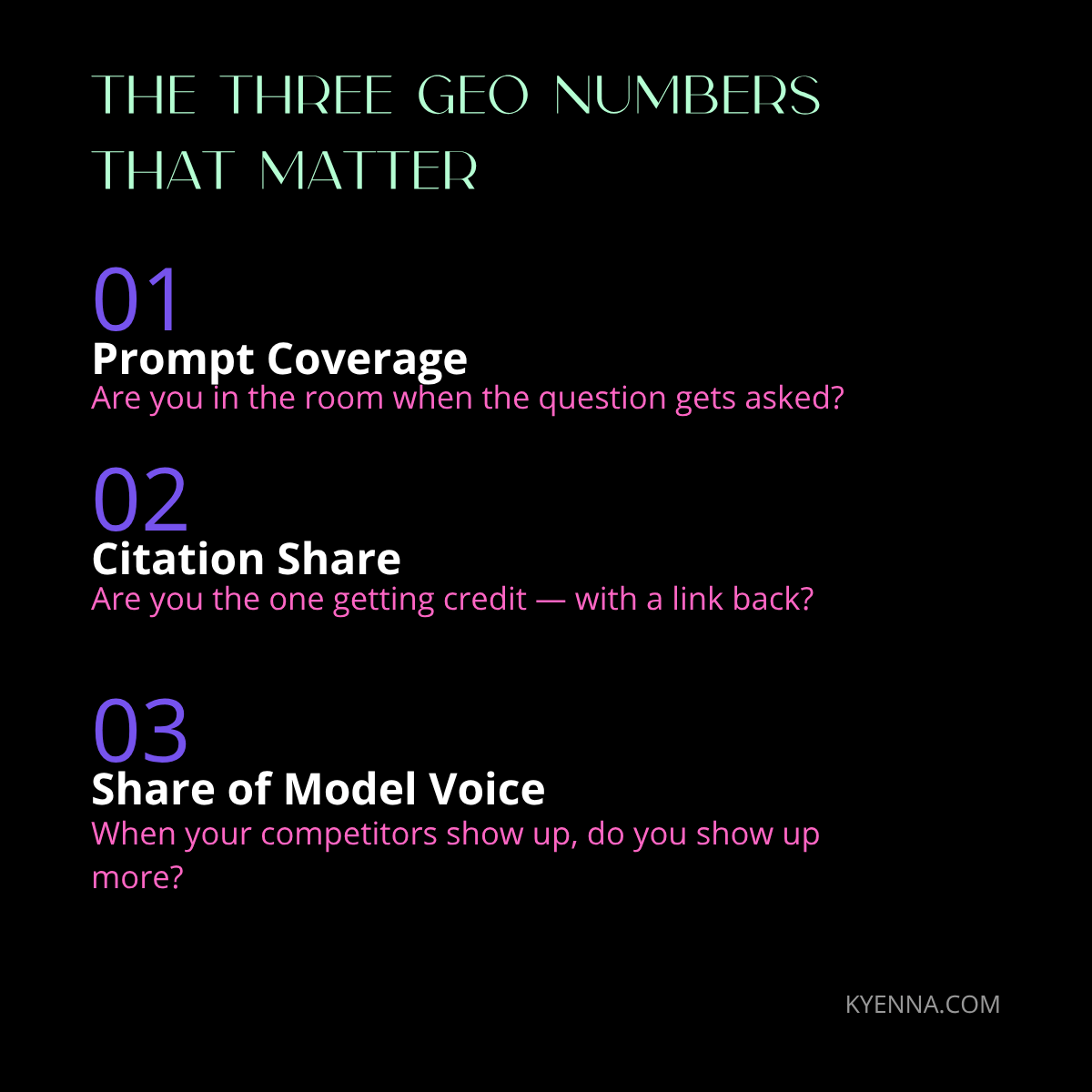
Three metrics matter for GEO, and they measure different things, so don’t blur them into one vague “are we winning” feeling:
Prompt Coverage: how often you show up at all
Citation Share: how often you’re the named, linked source
Share of Model Voice: how often you show up versus competitors
Prompt Coverage is whether your brand appears at all when an AI answers a relevant question, linked or not. The “are we even in the room” number.
Citation Share is narrower: how often you’re the named, cited source rather than a passing mention buried in a sentence. The “does it actually trust us” number.
Share of Model Voice is how often you turn up against your competitors for the same set of questions, which is the old share-of-voice idea relocated to a new venue.
If you’ve got a defined competitor set, Share of Model Voice is the one that matters most. If you’re a one-person operation, you can mostly skip it until you’re bigger and someone’s actually nipping at you.
The distinction earns its keep because a mention is not a citation, and a citation is not a recommendation. Most of the “we got cited by ChatGPT!” excitement going around is really Prompt Coverage, which is the softest of the three.
For what it’s worth, this is measurable at scale now. One researcher tracked 50,000 AI citations across six grounded engines over 90 days this spring, pulling live answers twice a week for thirteen weeks straight. The variables exist. They just aren’t the ones SEO trained you to watch.
How to check your AI visibility by hand in one afternoon
Open ChatGPT and Perplexity, ask the questions your buyers ask before they’ve ever heard of you, and write down whether you show up. That’s your baseline, and it costs nothing but a Tuesday.
The method, in order:
Write 20–25 buyer questions, the ones people type before they know your name. “Best freelance B2B copywriter,” “how do I audit my site for AEO,” not “Kyenna reviews.” Branded searches will flatter you and tell you nothing.
Run each one logged out, or in an incognito window, so your own history doesn’t quietly rig the answer in your favor. Source.
Run every prompt three to five times across both tools. AI answers wobble from one run to the next, so a single result is noise, not data. Each time, note whether you appeared, where you ranked, which competitors surfaced, and which sources got cited.
Tally it. Twenty-five prompts run five times is 125 data points: enough to see the obvious patterns, not enough to call statistically clean. (Say that part out loud to whoever you report to. Honest beats impressive, and it saves you from defending a number you know is shaky.)
If running a hundred prompts by hand sounds like precisely how you don’t want to spend your afternoon, a few free checkers will do the volume for you. Some run around forty prompts across ChatGPT, Perplexity, and Google’s AI surfaces automatically and hand you a breakdown. Free is free.
One more five-minute check almost everyone skips: can the bots even read your site?Free AI-crawl checkers test whether GPTBot, ClaudeBot, and PerplexityBot are being blocked at the door. If they are, none of the above can possibly work, and you’ve found your entire problem before lunch. (If you’re not appearing anywhere, start here. I wrote a longer piece on why sites go invisible in ChatGPT and Perplexity.)
What your existing analytics can (and can’t) tell you
GA4 and Search Console can show you AI’s downstream effect, the referral visits and the branded-search lift, but a large share of AI traffic is invisible to both, so read the trend instead of the headline number.
As of May 2026, GA4 automatically sorts recognized AI assistants (ChatGPT, Gemini, Claude) into a native “AI Assistant” channel. It’s real progress, but there’s a catch, and it’s a sizable one.
That channel only catches visits that arrive with an intact referrer, and somewhere between 35% and 70% of AI referral sessions show up with no referrer at all, which dumps them into “Direct” where they vanish into the pile. One analysis of roughly 450,000 AI-adjacent visits found 70.6% of them landed as Direct. Your real AI traffic is meaningfully higher than any “AI Assistant” line will ever admit to.
The free workaround, no developer required: watch your Direct traffic against your branded search volume in Search Console. If Direct is climbing faster than the number of people searching your name, that gap is very likely AI-influenced traffic GA4 couldn’t label.
Here’s real data pulled from my site, because real numbers beat hypotheticals.
My site is small enough that I can look at every session by hand, which makes it a decent test case. Over the last 90 days, Direct sessions went from 74 to 163 — more than doubled. Searches for my name grew over the same window too, just slower: impressions for “kyenna” went from 75 to 128, up about 70%.
Direct outran branded demand by a wide margin (for numbers that small), which is the exact gap the method above tells you to watch for. At my scale some of that is noise, and I’ll freely admit it. But the engaged time on those Direct sessions also climbed from barely a second to nearly a minute, which is what it tends to look like when real people start landing without a referrer instead of bots bouncing straight off. And there’s no “AI Assistant” channel in my GA4 to point at, so whatever AI traffic I’m getting is sitting in Direct under an assumed name.
The reason it’s worth the bother: According to Adobe, AI‑referred visitors convert about 42% better than organic search traffic, (based on data from over one trillion retail visits). It’s fewer visits, but they arrive much warmer, because the AI already did the convincing before they ever reached you.
When is it actually worth paying for a GEO tool?
Pay when manual tracking stops scaling: when you need weekly trend lines, a real competitor set watched over time, or proof to put in front of a client or a boss. Not before.
The afternoon method gives you a snapshot. It doesn’t give you a trend, and the trend is the whole point, because a single reading can’t tell you whether last quarter’s work moved anything. Paid GEO tools automate hundreds or thousands of prompts on a schedule. That’s what the subscription buys you: repetition and trend lines, not some insight you couldn’t reach on your own.
For a one-person business trying to claw its way to 500 monthly visitors, probably not yet. For a SaaS team tracking Share of Model Voice against five named competitors and reporting up the chain every month, yes. And even then, the manual pass is how you work out which prompts are worth automating before you pay anyone to automate them.
GEO being hard to measure isn’t the same as GEO not working. But “I can’t really measure it” is also not a license to fly blind for six months and assume the citations are stacking up somewhere out of view. A rough snapshot you actually took beats a polished dashboard you keep meaning to set up.
Besides, the tools finally gave us an “AI Assistant” channel (and then quietly routed most of the AI traffic into “Direct” anyway…) Measure what you can, by hand, and look at it monthly. Progress, sort of.
Want to know whether your site is even set up to be found by AI in the first place? That’s exactly what my free website audit checks for. And if you’d rather get this kind of thing in your inbox before the rest of the industry catches on, my newsletter is where I send it first.
Frequently Asked Questions
How often should I check my AI visibility?
Monthly is plenty for most small sites. The hand-run snapshot is a trend tool, not a daily dashboard, so you’re looking for movement across weeks, not refreshing it every morning. Quarterly is fine if you publish slowly.
Why does ChatGPT mention my brand one day and not the next?
AI answers vary from run to run, even for the same question. That variation is exactly why you run each prompt three to five times instead of trusting a single result and either celebrating or panicking over it.
Does getting cited by AI actually drive traffic or sales?
Sometimes, no click happens at all, and the citation itself is the win. But when AI traffic does land on your site, it tends to convert far higher than organic search, so judge it on quality of visit and branded-search lift rather than raw volume.
Is GA4’s “AI Assistant” channel accurate?
Directionally, not absolutely. It only counts visits that arrive with a referrer, and a large share of real AI traffic shows up without one and hides in Direct. Treat the “AI Assistant” number as a floor, not a full count.
Do I need a paid GEO tool to measure this?
No. Manual prompt testing plus GA4 and Search Console covers a small business comfortably. Pay only when you need automated, scheduled trend data or competitor tracking that’s too much to run by hand.