7 Website Copy Mistakes That Quietly Cost You Clients
Bad copy is quiet. It doesn't show up in your analytics labeled "bad copy." It looks like a bounce rate you can't explain, a services page with decent traffic that somehow never converts, and a contact form that collects maybe one inquiry a month and you're honestly not sure if that's normal or a problem. You keep tweaking the design. You update the colors. You add a new section header. The problem is not the section header.
Here are the copy mistakes showing up on small business websites most consistently, the ones that affect both search visibility and whether visitors actually do anything once they arrive.
Mistake 1: Your homepage doesn't say what you do
ATen seconds. That's roughly the window before users leave a web page, unless a clear value proposition makes them stay—that figure comes from Nielsen Norman Group's research on how long people stay on web pages. Survive that first harsh judgment and visitors will look around; fail it and they're still highly likely to leave in the next 20 seconds. So if those opening seconds are a full-screen image, a vague tagline, and a button that says "Explore," you've spent the window and said nothing.
“Helping businesses thrive.” “Where vision meets strategy.” “Creating impactful experiences for forward-thinking brands.” These could describe a graphic design firm, a wedding photographer, a management consultancy, or a stationery store, and they tell your actual ideal client nothing about whether you’re the right fit. Specificity is what builds trust. Vagueness just makes people work harder to figure out if they should stay.
Your homepage headline should answer three questions before anyone scrolls: what you do, who you do it for, and what changes when someone works with you. Not in a brand statement way. In a “I need this to be obvious without effort” way.
Mistake 2: Writing for yourself, not your reader
Service pages are the biggest offenders. They list what you do, your process, your credentials, your approach, and they're often quite thorough about all of it. What they don't do is answer the question every visitor is running silently in the background: what does this mean for me specifically?
Features describe what something is. Benefits describe what it does for the person reading. "I write website copy" is a feature. "You get a site that shows up in search results and actually sounds like you" is a benefit. Both belong on a services page. Benefits should lead.
Read your services page and count how many sentences start with "I" or "We." Then count how many describe something the client actually experiences. Most service pages run heavily weighted toward the seller, which means the page is mostly a monologue about the person offering the thing rather than a conversation with the person who might need it. This is fixable. It just doesn't feel urgent until it costs you something.
Mistake 3: No heading structure
This is where copy and SEO converge most directly. Every page on your site should have one H1, your main headline, and a logical hierarchy of H2s and H3s below it. Not because it looks organized in your page editor, but because heading structure is how search engines understand what a page is actually about.
If your service page is a wall of text with no headings, Google has to guess what the page covers. Google guessing is not a situation you want to be in.
Headings also give human readers a way to scan before they commit to reading. Most people do this — they look at the structure first to decide if it's worth their time. A page with no logical entry points loses those people before they ever reach your strongest copy. (If you want to check your own hierarchy, here’s how to audit your site without the existential crisis.)
Mistake 4: Generic calls to action
"Contact me." "Learn more." "Get in touch." These CTAs are everywhere, and they do the bare minimum. "Contact me" is technically a call to action in the same way that a door is technically a destination. Accurate. Not doing any persuasive work.
A CTA that converts has two elements: clarity about what happens next, and a reason to take that step. "Book a free 20-minute call" is better than "Contact me." "Get the free audit checklist" is better than "Download." "See how this works" is better than "Learn more." You don't have to rewrite your entire site to fix this. Go page by page and replace every generic CTA with one that answers: what exactly is the next step, and why would I take it?
Mistake 5: Keyword avoidance, or keyword stuffing
Both extremes cause problems, and people tend to swing between them depending on the last piece of SEO advice they read.
If your services page never mentions "copywriter," "content strategy," or "website copy" because you've been told to write naturally, search engines have a genuinely hard time understanding what you offer. Keywords in your page title, H1, and the first paragraph of any page are where they matter most. This is not stuffing. It's basic orientation.
The opposite problem is copy that reads like someone had a word count requirement for a specific phrase: "Our website copywriting services offer website copywriting solutions for businesses seeking website copywriting help." That approach used to work, didn't work particularly well even then, and now actively signals something is off to both search engines and the human reading it.
The functional middle: know what you want each page to rank for, use those terms in the places that matter, and write for the person reading. One of those outcomes takes care of the other.
Mistake 6: No internal links
Internal links are nearly invisible to visitors, which is exactly why they get skipped. They connect your pages to each other, distribute authority across your site, and keep visitors from hitting a dead end.
A blog post about content audits should link to your content strategy services. A services page should link to relevant case studies. Your about page should point somewhere useful: your services, your process, your free resource, rather than being a destination page that visitors leave from because there’s nowhere obvious to go next.
If someone reads your most popular post and then leaves because there’s no clear path forward, that’s a copy problem wearing a traffic problem’s clothes.
Mistake 7: Service pages that list features, not outcomes
Mistake 2 was about who your copy talks about. This one's about what comes first. You can have every outcome and every benefit on the page and still bury them under the logistics.
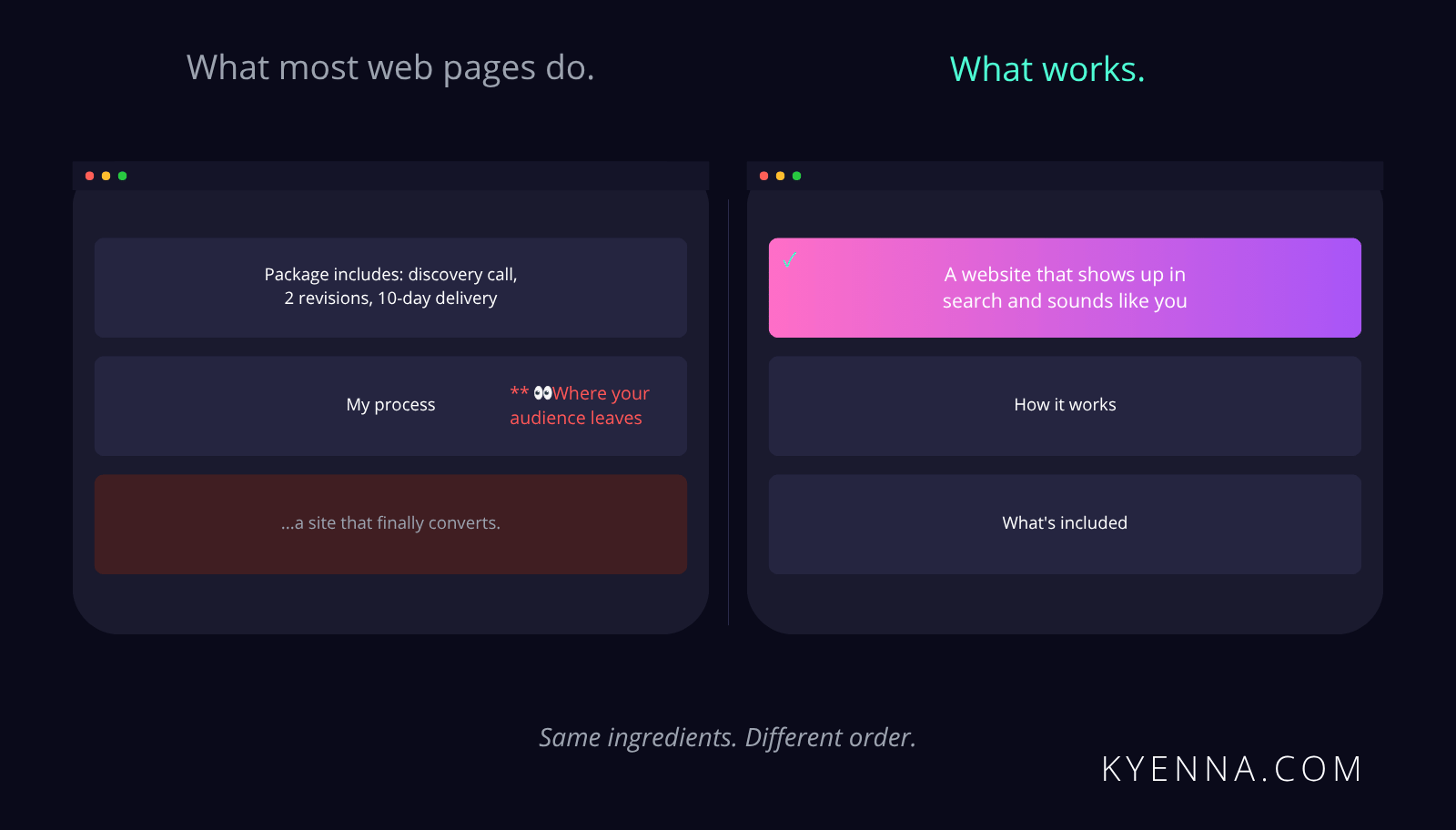
The pattern looks like this: the page opens with the deliverables. "Package includes: initial discovery call, two rounds of revisions, final delivery in 10 business days." Accurate, and completely backwards. That's the reassurance you give someone who has already decided to hire you, not the reason they decide in the first place.
Lead with what changes for them. The outcome earns the click; the mechanics close the doubt once they've clicked. Same ingredients, reversed order, and the page starts working. Almost every service page on the internet has these two flipped.
A quick diagnostic: read your site out loud, from start to finish, and note every moment you stop believing it or stop being interested. Those are your problem areas. They're usually more obvious in audio than on screen, for reasons that remain unclear.
If you want a faster version of this check, the free 10-Point Website Quick-Check covers the major copy and SEO issues in yes/no format.
Frequently asked questions
How do I know which pages to prioritize for copy improvements?
Start with the pages that do the most work: homepage, primary services page, and whatever page you’re currently sending people to from social media or email. These three drive the most decisions. Fix those first, then move to everything else.
Do I need to rewrite everything at once?
No — and trying to is usually what makes it never happen. One page, improved properly, is more useful than a full-site rewrite you start and don’t finish. Pick the most important page and start there.
Can bad copy hurt my SEO rankings?
Yes, indirectly. If visitors leave quickly and don’t engage with your content, those behavioral signals tell search engines your page isn’t relevant to what people are searching for. Good copy and good SEO end up reinforcing each other, which is convenient since you have to do both anyway.
Should I hire a copywriter or fix this myself?
It depends on how much time you have and what the stakes are. Most structural fixes (heading hierarchy, internal links, CTAs) are DIYable with a few hours and a clear checklist. Voice, positioning, and conversion copy for your primary sales pages are worth professional help if those pages are actively costing you clients, because the ROI is there.
What’s the difference between a copywriter and a content strategist?
A copywriter writes the words on the page. A content strategist decides which pages exist, what each one needs to do, and how they connect, before anyone writes a word. Most small sites need a bit of both: strategy so the pages aren’t fighting each other, copy so each one actually lands. (More on the strategy side in the content strategy guide.)