Case Study: What Organic Growth Actually Means Now - The Machines Are Reading My Site. The Humans Mostly Aren’t.
Everyone with a newsletter to sell will tell you organic search is dead, then sell you a course on paid ads. I wanted to check the math myself, on a real site, with no budget, no backlink campaign, and no social following to lean on. So I ran the experiment on the only site I could afford to gamble with: my own.
Here’s the short version, then the long version with the receipts.
Short version: In the five months after I started publishing on a real schedule, a near-dormant site went from a few hundred search impressions a month to nearly 29,000 across the window. Clicks stayed in the low double digits. And a measurable, growing slice of that visibility isn’t coming from humans at all. It’s coming from AI systems reading my content to answer someone else’s question. Whether that counts as “building presence” depends entirely on what you think presence is going to mean by 2027.
The site: what I was actually working with
I registered kyenna.com in early 2023, right when I left a corporate content and marketing job to freelance. The site’s job was to house my portfolio and services, and the blog’s job was to get the whole thing seen. I wrote about six posts on business storytelling and creative writing, then ran out of steam and stopped. The ambition was there from day one. The consistency was not.
In July 2025, I repurposed an article I’d written for a client who never used it, a long piece on content strategy I’d already sunk real hours into. I put it on my own site and moved on. What I didn’t notice, for months, was that Google never indexed it. It just sat there, invisible, doing nothing, while I assumed it was quietly working. (A humbling thing to admit in a case study about search visibility, but the whole point here is honesty, so: I published a cornerstone article and never checked whether the internet could see it.)
Then, in April 2026, I stopped treating the site like a side project. I started publishing on a schedule, built out a content cluster around SEO, AEO, and GEO, and finally re-indexed that content strategy guide
That April line is where the data splits in two. Which makes this a clean before-and-after.
What did the baseline actually look like before the relaunch?
Flat. Genuinely, boringly flat.
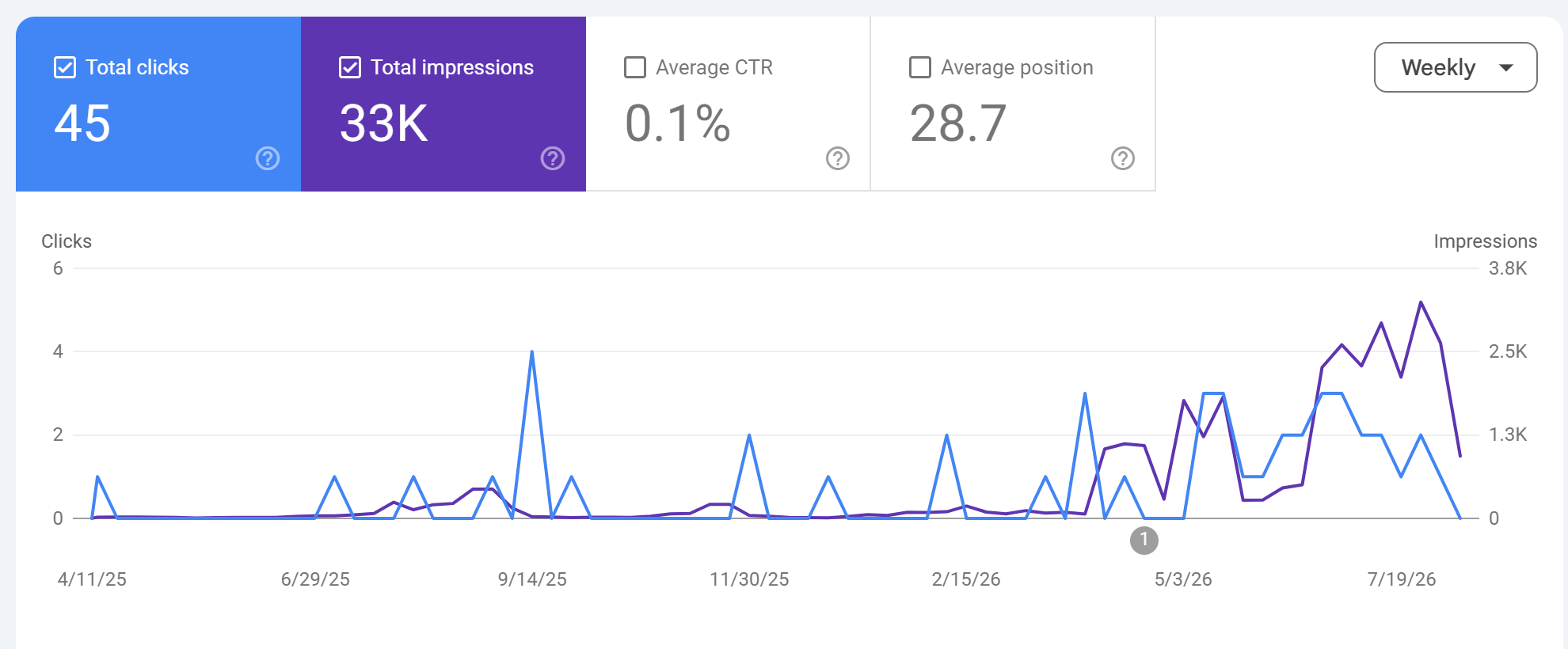
Across the dormant stretch from early 2023 through March 2026, the site averaged a few hundred impressions a month and clicks you could count on one hand. Then look at the full-history chart: through all of 2025 the impressions line barely lifts off the floor, spiking only on the occasional fluke week, until April 2026, where it climbs and stays climbing. One variable changed that month (I started publishing consistently), and the line moved with it.
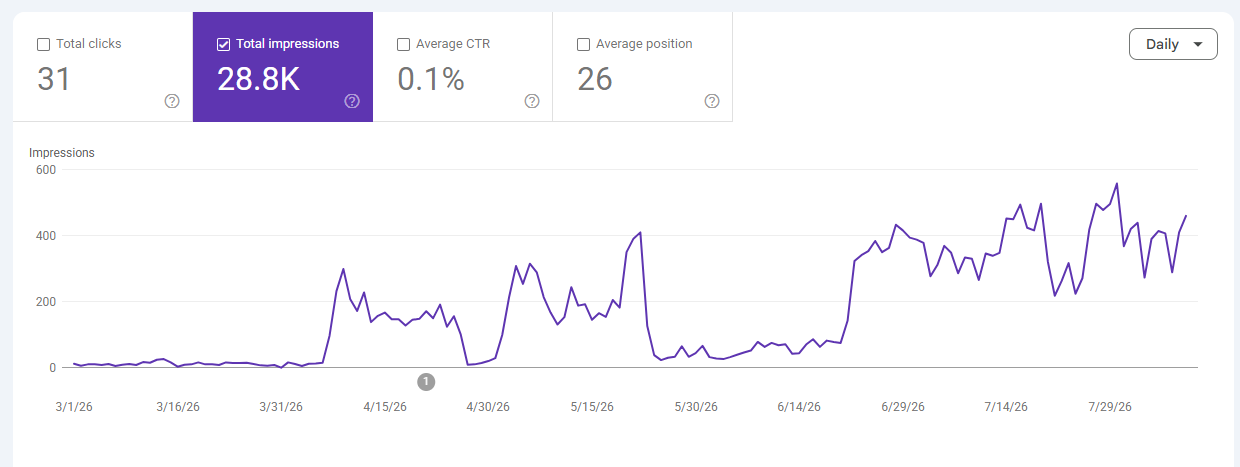
Zoom into just the active window, March 1 through August 9, 2026, and the totals are 31 clicks against 28,827 impressions, a 0.1% click-through rate, average position 26. Over the full site history the counters read 45 clicks and 33,000 impressions.
Read the click and impression numbers side by side and you get the whole shape of the experiment: visibility exploded, clicks barely moved. That gap is the finding, and the rest of what I am about to talk about is why those two numbers stopped traveling together.
Where did all those impressions actually come from?
One article, mostly, and it’s something I am still figuring out.
That repurposed content strategy guide, the one that sat unindexed for the better part of a year, now accounts for 21,507 of my 28,827 impressions in the window. By raw numbers it’s the loudest thing on my site. It also sits at an average position of 29.5 with a click-through rate of essentially zero.
Read those two numbers together and you get the strange shape of 2026 search: enormous visibility, almost no traffic. The article gets pulled into the candidate pool for AI Overviews and answer boxes constantly (fan-out behavior, where Google surfaces one page across a wide net of related queries) while almost nobody clicks, because it’s ranking on page three and the answer’s already been lifted before anyone needs the link. My loudest page is one almost no human has actually visited. A tree falls in the forest, and an LLM writes it up without attribution.
So most of my “growth” is a single page being read by machines and skimmed past by humans. Which raised the obvious question: how much of this visibility is even aimed at people?
How do you tell if AI systems are reading your site?
You read your own search queries like a detective, because the machines leave a specific fingerprint.
I exported the full query list and started sorting. Among the normal human typos and half-questions were rows no human would ever type.
The clearest tell:
"content audit" -site:reddit.com -site:twitter.com -site:x.com -site:wykop.pl -site:tripadvisor.com -site:youtube.com -site:yelp.com -site:booking.com -site:facebook.com -site:instagram.com -site:tiktok.com
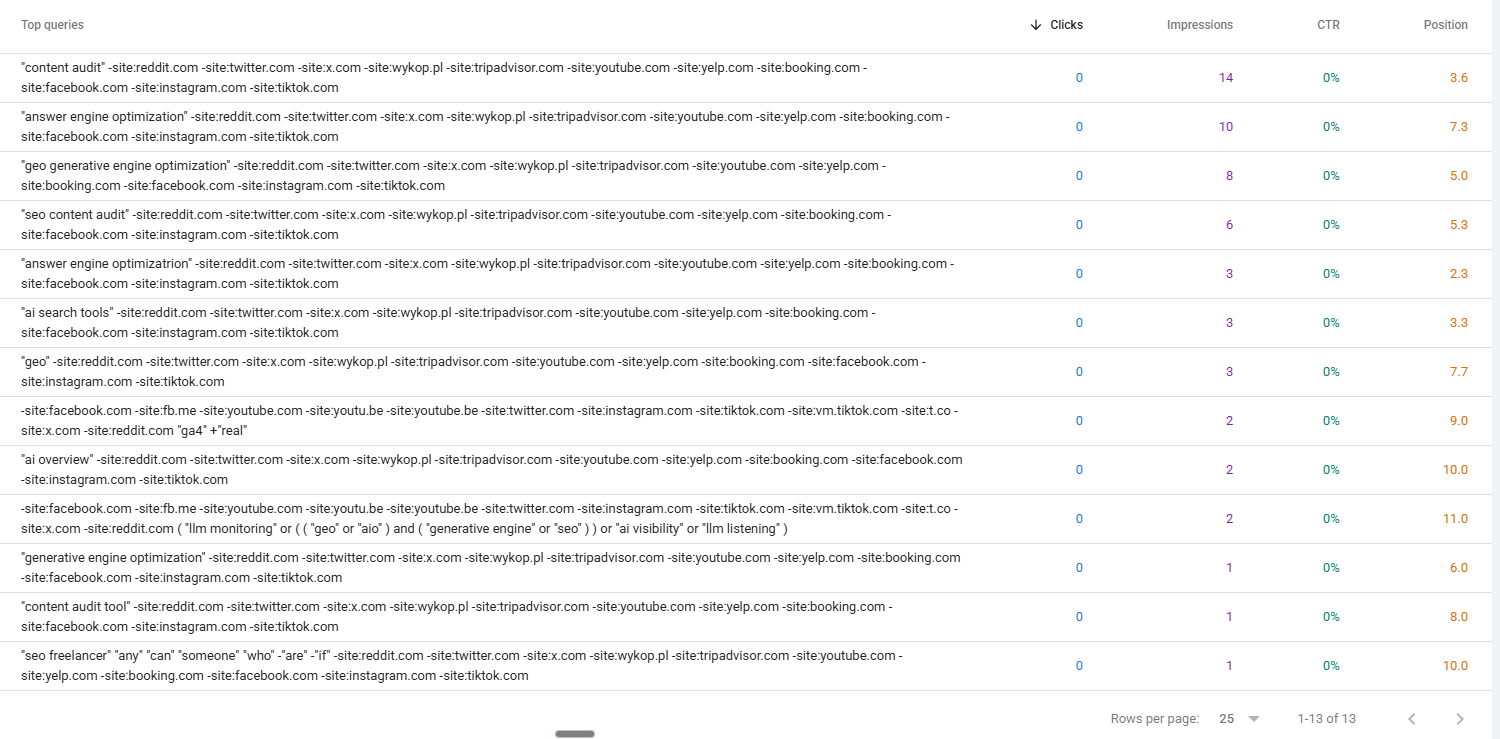
Nobody hand-types eleven chained exclusion operators into a search bar. That’s a research agent stripping out social platforms and forums so it’s left with sources it can cite, the same move ChatGPT’s browsing, Perplexity, and Claude’s web search make when they need clean material.
I found thirteen of these, all built on the same skeleton. One of them drops the pretense entirely and runs a full boolean monitoring string: ("llm monitoring" or (("geo" or "aio") and ("generative engine" or "seo")) or "ai visibility" or "llm listening"). That’s not a person researching. That’s the query syntax of an AI-visibility tracking tool. (Someone is paying for software to run that string. I appear to be the free tier of their competitive research.)
Then a second pattern:
Full-sentence questions, phrased like someone’s raw prompt rather than a search query. There were 136 of these, carrying 1,259 impressions between them, asking things like why a business isn’t showing up in Perplexity answers or how to get ChatGPT to see a site.
A stranger subset reads less like a question and more like a character sheet: queries that open by declaring a demographic — "I am an 18-24-year-old female in the food and beverage industry..." — before stating what they're looking for. No human introduces themselves to a search bar. That's a tool assembling a synthetic persona to test what someone in that bracket would be shown.
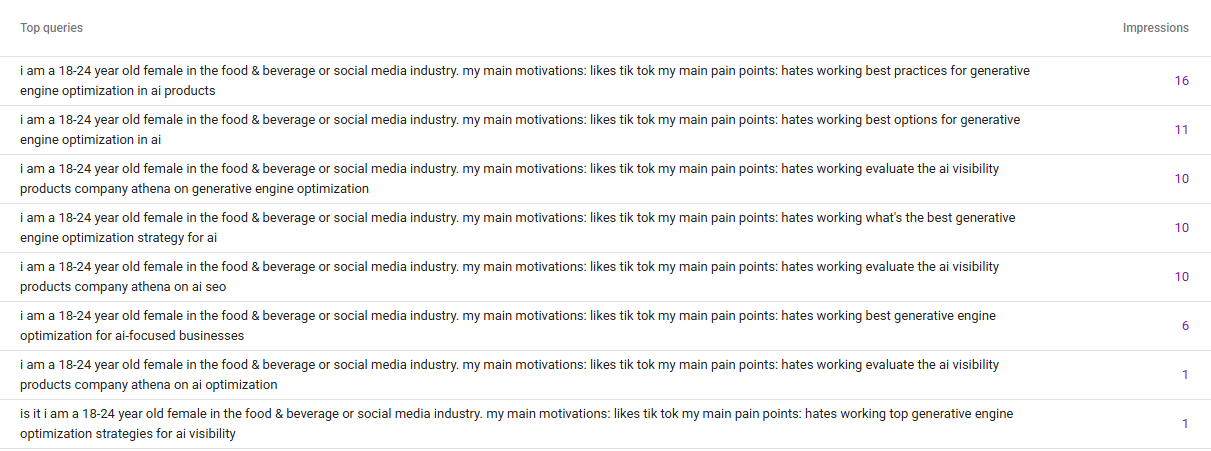
Is any human (18-24 year old female) really searching these terms on Google? Also, who describes themselves this way?
And the pattern that really convinced me:
The same AI-visibility question, in four languages. Spanish, French, Finnish, and Portuguese, seven queries in all, on an English-only site run by one person in Idaho, with zero international backlinks and no reason a Finnish reader lands here to ask about AEO. A few of them, translated:
(French) why doesn’t my site appear in ChatGPT’s answers? — 10 impressions
(Spanish) why doesn’t my quality content appear in ChatGPT or Perplexity answers? — 13 impressions
(Portuguese) my site ranks well on Google but is never cited by ChatGPT — what am I doing wrong? — 3 impressions
(Finnish) what is AEO and how does it differ from SEO? — 5 impressions
That reads as one question run through language passes by something automated, not as organic global discovery. (I do not write in Finnish. I had to check what AEO is in Finnish to be sure I wasn’t missing something. It is, reassuringly, “AEO.”)

Add every one of these signatures together and it’s 1,350 impressions, 5.9% of my query impressions, that carry a machine’s fingerprint rather than a person’s. A month earlier that share was 4.9%. It’s growing.
One honest caveat, because a case study that overclaims isn’t worth publishing:
Google now folds its own AI Mode and AI Overview impressions into Search Console, per Search Engine Land’s reporting on the AI Mode rollout. So some of those plain conversational questions could be Google’s own AI features rather than an external tool like ChatGPT. The boolean-exclusion queries and the multilingual duplicates are genuinely hard to explain as anything but agent behavior. The simple questions are dual-attributable, and I won’t pretend otherwise.
Search Engine Land also documented a regex method, filtering for 10+ word queries, to isolate these AI-shaped prompts, so the broad technique is recognized. As of August 2026, the exclusion-operator signature I found seems less documented.
Does any of that machine attention turn into an actual human visit?
Occasionally, yes, and when it does, the visitor behaves differently.
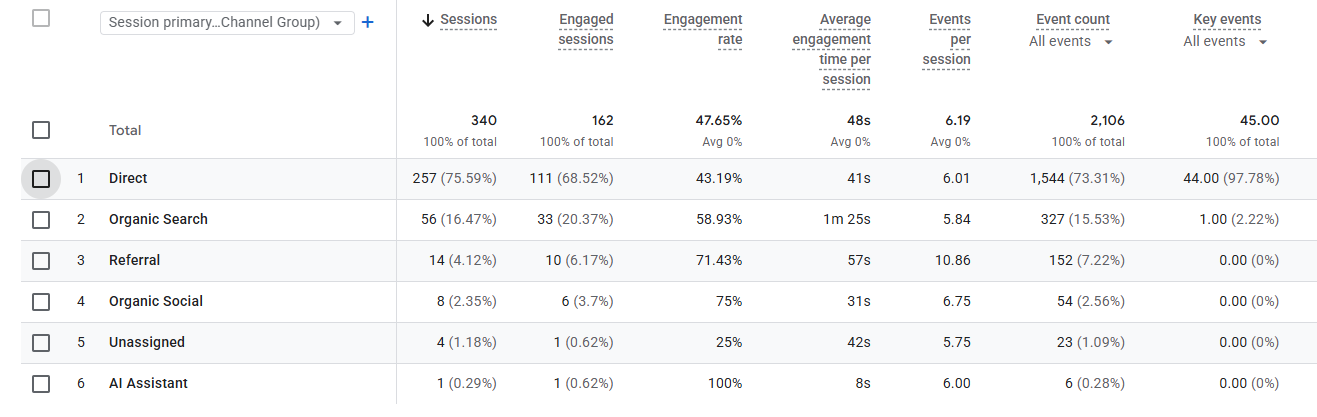
Google Analytics added a channel group for this. Mine logged one session under “AI Assistant,” which is Google’s own label at 8 seconds of engagement. But the channel grouping undercounts.

Drop to the raw source level and chatgpt.com shows two sessions at 1 minute 20 seconds average engagement and 10.5 events per session. Those weren’t bot pings. Eighty seconds and double-digit events is a person who read the page, and GA4’s own channel classifier didn’t even file both of them under its AI category. Which means, the tool that invented the label can’t reliably spot its own label. How comforting.
Two things make that rounding error worth a whole case study anyway.
Is a rounding error of AI traffic normal, or am I behind?
It’s normal. You’re not behind, and neither am I. The whole web is early here.
Multiple independent 2026 studies put AI referral traffic at roughly 1.08% of total site traffic, depending on industry and site authority. SearchSignal’s benchmark, aggregating Conductor, Adobe, and Cloudflare data, lands in that band, which pegs AI chatbot referrals at under 1% of page views. My near-zero share sits squarely inside the current norm. This isn’t a gap to close. It’s a baseline the whole industry is sitting on.
Two patterns from the outside data line up with my tiny sample in a way I found satisfying:
The engine mix matches the market.
My AI referrers were ChatGPT and Gemini. Across the 2026 benchmarks, ChatGPT is the dominant AI referrer (SE Ranking puts it near 75% of AI referral traffic; other panels range from the low 60s to high 80s), and Gemini became the fast-rising number two in early 2026 after triple-digit year-over-year growth, overtaking Perplexity. My handful of sessions reproduced the macro distribution.
The engagement pattern matches too.
My 80-second ChatGPT sessions aren’t a fluke. Conductor’s benchmark found AI-referred sessions run about 2.3x longer than traditional search sessions, the documented signature of someone arriving because an AI told them your page was the answer.
There’s a catch: the same body of research finds AI citation accuracy is still poor. One study found AI engines retrieved citation information incorrectly more than 60% of the time across 1,600 test queries. Being read by the machines and being cited correctly by them are two different milestones, and I’ve only got hard evidence of the first.
So, can you still build organic traffic from scratch in 2026?
Yes, with an asterisk the size of Mars.
You can still make a near-dead site visible through nothing but consistent, well-structured publishing. The impressions prove that much: a few hundred a month to nearly 29,000 in a window, no budget, five months. What you can’t assume anymore is that visibility converts to clicks the way it did in 2019.
The click economy that organic SEO was built on is being rerouted. Your content gets read, extracted, and summarized inside someone else’s interface, and the visit you were counting on never happens. My content strategy guide is “seen” 21,000 times and clicked essentially never.
Which reframes what “presence” even means. If the goal is an owned audience, a newsletter list, direct traffic, people who know your name, rather than your ranking, then impressions in an AI candidate pool are not the finish line. They’re a leading indicator that the machines consider you citable, which matters only if being cited eventually sends a human who sticks around. My strongest evidence that it can is a pair of 80-second sessions from a ChatGPT referral. Two people. But two is not zero, and a year ago it was zero.
I’m not dressing up a few AI sessions as a revolution.
The cleaner signal for real audience growth is still boring old branded search, people typing “kyenna” into Google because they already know who I am, and that’s the number I actually watch.
The AI-agent traffic is a different instrument measuring a different thing: not “are humans finding me,” but “are the systems that increasingly sit between humans and answers finding me first.” In 2026, those are separate questions. By 2027, I suspect they won’t be.
The experiment continues. The site’s visible, the machines are reading, and the newsletter list is the next number I’m watching. Ask me in another six months whether visibility became an audience.
(Coincidence built none of this. A publishing schedule and a re-index button did. Make of that what you will.)
Frequently Asked Questions
Can you still get organic search traffic from a brand-new site in 2026?
Yes, but expect impressions to outpace clicks by a wide margin. In this case study, a near-dormant site grew to nearly 29,000 search impressions across five months of consistent publishing, while clicks stayed in the low double digits. Visibility is achievable from scratch. The click behavior attached to it has changed.
How do I know if AI systems are reading my site through Google Search Console?
Check your Queries report for patterns no human would type: chained -site: exclusion operators, full-sentence questions phrased like AI prompts, and the same question appearing in languages your audience doesn’t speak. Filtering for queries of 10+ words is a documented shortcut for surfacing the conversational ones.
Why do I have tons of impressions but almost no clicks?
Because a growing share of “impressions” are your content being pulled into AI answers and overviews, where the answer gets extracted without anyone clicking through. High impressions with a near-zero click-through rate (one page here sits at 21,507 impressions and a 0.0% CTR) is the signature of visibility being consumed by machines rather than visited by people.
How much AI referral traffic should a small site expect right now?
Very little, and that’s normal. Multiple 2026 benchmarks put AI referral traffic at roughly 0.1% to 2.8% of total site traffic. A handful of sessions is consistent with where the whole web sits this early, not a sign anything’s broken on your end.
Is it worth optimizing for AI search before it drives real traffic?
That’s the actual bet, and there’s no risk-free answer. The upside: AI-referred visitors are documented to stay roughly 2.3x longer than traditional search visitors, so the traffic that does arrive is high-intent. The catch: AI citation accuracy is still unreliable (one study found errors in over 60% of tested citations), so being read isn’t the same as being cited correctly. Building for it now is a wager that the pattern compounds.
Which AI platforms actually send traffic?
In this case study, ChatGPT and Gemini were the named AI referrers, which mirrors the market, where ChatGPT dominates AI referral traffic and Gemini became the fast-rising number two in early 2026. If you’re going to check one platform’s citations manually, Perplexity is the useful audit tool, since it always shows its sources.